

When Certainty Becomes a Cage: Anti-Catholicism and the Paradox of the American Founding

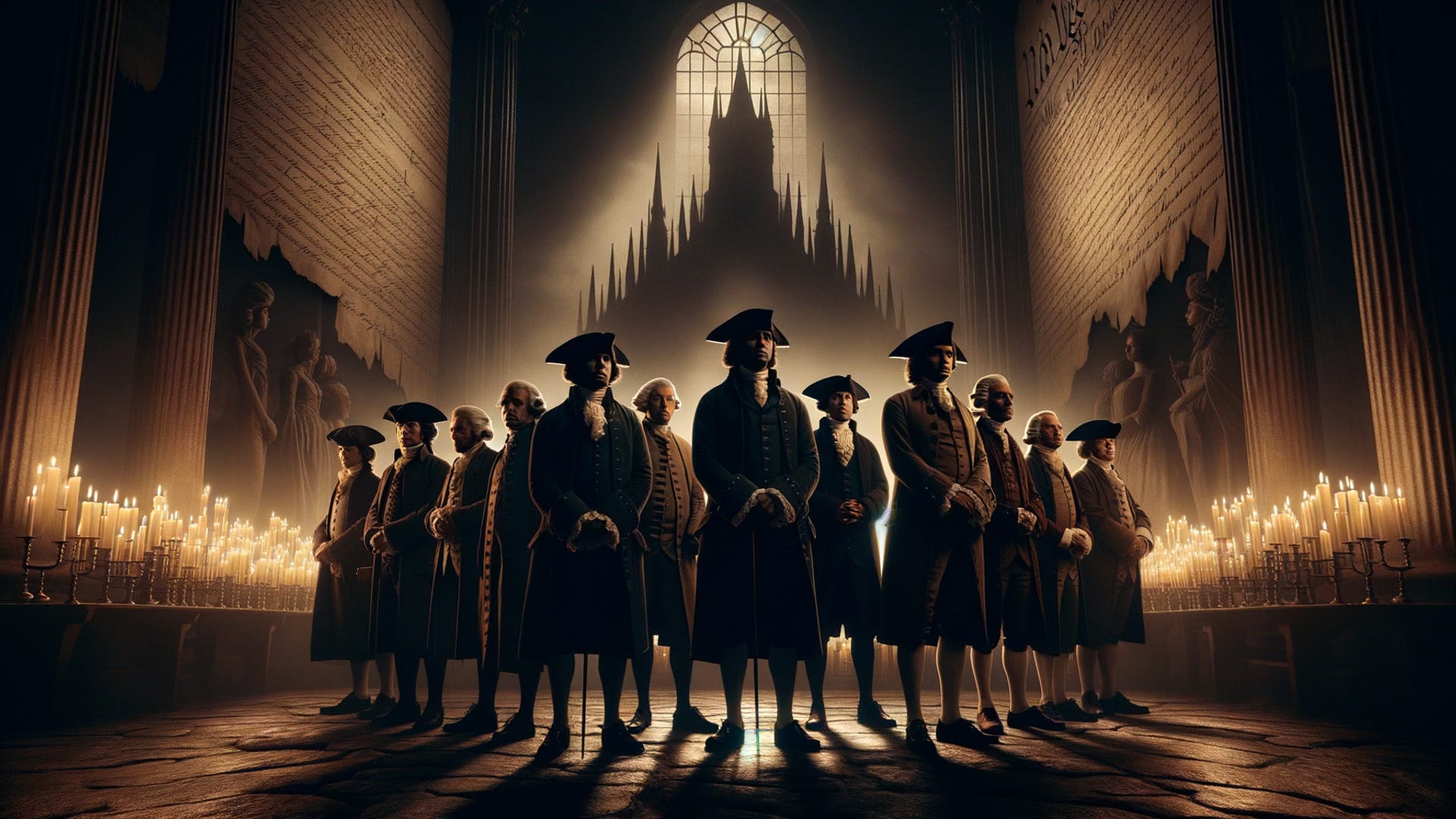
The American founding is often celebrated for its restraint, its suspicion of concentrated power, and its institutional humility. Yet embedded within this posture was a striking contradiction: a pervasive and deeply confident belief that one institution—the Catholic Church—represented an existential threat to liberty. Early Americans were famously anti-Catholic, and not merely in cultural temperament but in political imagination. Popery, hierarchy, and ecclesiastical authority were treated as near-synonyms for tyranny.
The irony is difficult to ignore. The same generation that warned relentlessly against moral certainty, factional domination, and unchecked authority often spoke about Catholicism with precisely the kind of confidence they claimed to fear. Their certainty about the dangers of the Catholic Church may itself illustrate the very phenomenon they sought to restrain.
Anti-Catholicism as Inherited Certainty
Anti-Catholicism in colonial America was not accidental. It was inherited—politically, culturally, and theologically—from England. English Protestant identity had been forged in opposition to Rome, shaped by memories of the Marian persecutions, the Spanish Armada, and centuries of religious conflict in which Catholicism was associated with absolutism and repression.
By the eighteenth century, this inheritance had hardened into assumption. Catholicism was not merely another Christian tradition; it was imagined as a political system masquerading as a religion, one that subordinated conscience to hierarchy and loyalty to a foreign power. To many early Americans, the Church represented the fusion of certainty and coercion they most feared.
In this sense, anti-Catholicism functioned as a kind of moral shorthand. It required little examination because it seemed self-evident. The danger of Rome was assumed, not argued.
Madison, Faction, and the Blind Spot
In The Federalist Papers, particularly Nos. 10 and 51, James Madison articulates a profound skepticism toward moral certainty in politics. Factions, he argues, arise not merely from selfish interest but from sincere disagreement about justice and the good. When such disagreement gains power, it becomes oppressive.
Yet here is the tension: Madison and his contemporaries were remarkably confident that Catholicism, if granted influence, would inevitably produce the very tyranny they sought to prevent. This belief was rarely subjected to the same structural skepticism applied to other forms of conviction.
The Catholic Church was treated not as one faction among many, but as an exception—uniquely dangerous, uniquely incompatible with liberty. In effect, early Americans exempted their anti-Catholic certainty from their broader critique of certainty itself.
Certainty Justified by History
To be fair, this confidence did not arise in a vacuum. European history provided ample evidence of religious coercion, much of it associated with Catholic states and institutions. The founders were not inventing a threat; they were responding to a record.
But history can justify fear without sanctifying certainty. The crucial question is not whether the founders had reasons to be wary, but whether their conclusions hardened into absolutes—moral conclusions so settled that they no longer required restraint.
If Federalist No. 10 warns that factions driven by moral confidence will seek domination, then anti-Catholicism presents an uncomfortable case study. It was a moral certainty shared widely enough to feel natural, even virtuous. And because it was shared, it rarely appeared as factional at all.
The Catholic Church as Symbol Rather Than Reality
In this light, Catholicism functioned less as a lived religious reality and more as a symbolic repository for American anxieties about authority. The Church became the embodiment of everything the founders rejected: hierarchy, tradition, sacrament, obedience.
This symbolic role mattered more than accuracy. The actual diversity of Catholic thought, practice, and political behavior was largely irrelevant. What mattered was what Catholicism represented in the American imagination: certainty backed by power.
Ironically, this abstraction mirrors the very danger Madison warned against. When an idea becomes a symbol rather than a reality, it no longer invites engagement. It invites containment.
Turning the Tables: Certainty Against Certainty
Here the tables truly turn. If the founders were correct that unchecked certainty leads to domination, then their own certainty about Catholicism demands scrutiny. Not because Catholicism was harmless, nor because the founders were malicious, but because certainty—once justified—rarely recognizes its own limits.
The American constitutional order was designed to restrain power precisely because humans believe they are right. Yet early Americans exempted one belief from this logic: their belief that Catholicism could not coexist with liberty.
This exemption reveals the difficulty of practicing epistemic humility consistently. It is one thing to design institutions that restrain others’ certainty; it is another to restrain one’s own.
The Long-Term Consequence
Over time, the anti-Catholic certainty of early America eroded—not primarily because of abstract arguments, but because reality intruded. Catholic immigrants participated in civic life. Catholic politicians upheld constitutional norms. The feared collapse of liberty did not occur.
What changed was not the Constitution, but the certainty. Experience exposed the limits of inherited assumptions.
In retrospect, this evolution reinforces Madison’s insight rather than undermining it. The Constitution endured precisely because it did not encode anti-Catholic certainty into its structure. It allowed a belief widely held by the founders to be tested, moderated, and eventually revised.
Had that certainty been constitutionally entrenched, it would indeed have become a cage.
A Founding Lesson Unfinished
The early Americans were right to fear the fusion of certainty and power. They were right to design a system that frustrates moral absolutism. But they were not immune to the very temptation they diagnosed.
Their anti-Catholicism stands as a reminder that certainty often feels most justified precisely where it is least examined. The danger is not conviction, but conviction exempt from restraint.
In this sense, the American founding offers not a finished lesson, but an unfinished one. Federalist Nos. 10 and 51 teach us to distrust certainty in politics. The founders’ own blind spots remind us how difficult that discipline is to sustain.
When certainty becomes a cage, it rarely announces itself as such. It arrives wearing the clothes of wisdom, history, and moral clarity.
And that, perhaps, is the most enduring warning the founding generation left behind—whether they intended to or not.